

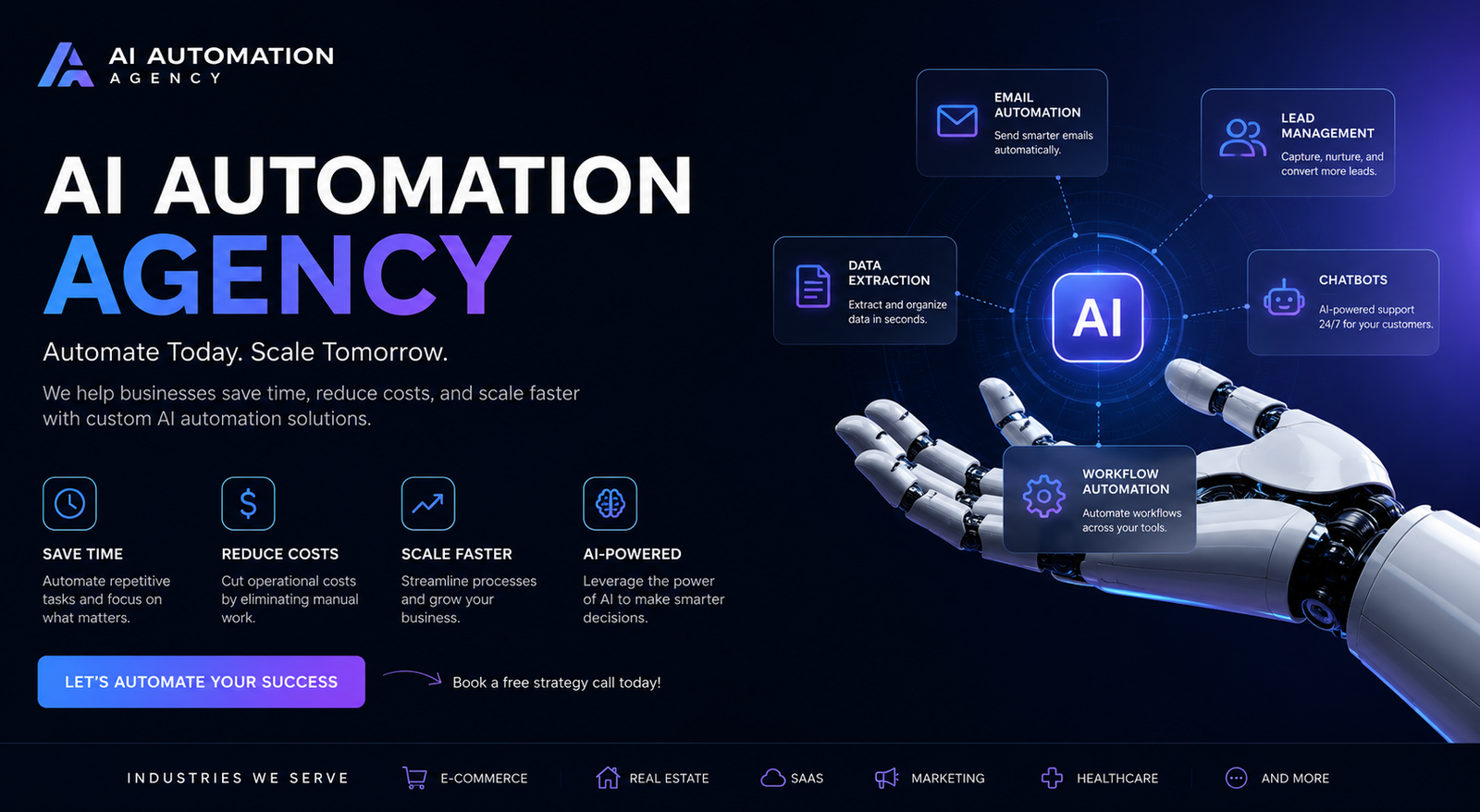
Artificial intelligence has moved beyond simple chatbots and futuristic concepts. Today, businesses of every size are using AI to automate repetitive tasks, improve customer experiences, and reduce operational costs. From handling customer inquiries to managing sales pipelines and processing invoices, AI-powered automation is transforming how organizations work.
This shift has created a growing demand for every AI automation agency that specializes in designing intelligent workflows tailored to business needs. Instead of replacing employees, these agencies help teams eliminate repetitive work, allowing them to focus on strategy, creativity, and high-value decision-making.
Whether you're a startup founder, an eCommerce business owner, or an enterprise looking to scale operations, partnering with the right agency can dramatically improve productivity. In this guide, you'll learn what an AI automation agency does, the services it offers, how implementation works, and how to choose the best partner for your business.
What Is an AI Automation Agency?
An AI automation agency is a company that helps businesses automate processes using artificial intelligence, machine learning, workflow automation platforms, and AI-powered software. Rather than simply connecting apps together, these agencies build intelligent systems capable of making decisions, understanding language, analyzing data, and completing complex tasks with minimal human intervention.
Unlike traditional automation that follows fixed rules, AI automation learns from data and adapts to changing situations. For example, instead of routing every customer email to the same department, AI can analyze the message, determine customer intent, assign priority, and send it to the right team automatically.
Businesses often hire an AI automation agency to improve efficiency, reduce costs, enhance customer service, and accelerate growth without increasing workforce size.
How AI Automation Works
Most AI automation projects combine several technologies working together.
A customer action—such as filling out a form or sending an email—triggers an automated workflow. AI then processes the information, determines the appropriate response, and performs actions across connected systems like CRMs, accounting software, email platforms, or project management tools.
For example, a customer submits an inquiry, the AI analyzes the message, updates the CRM, drafts a personalized response, alerts the sales team with a qualified lead, and instantly sends a confirmation email to the customer. Instead of requiring multiple employees, the entire process happens automatically within seconds.
AI Automation Agency Services
Modern agencies offer much more than chatbot development. Their goal is to automate complete business operations while improving accuracy and customer satisfaction.
AI Workflow Automation
Workflow automation connects different business systems so tasks move automatically from one step to another. Common examples include employee onboarding, invoice approvals, order processing, document routing, internal approvals, and lead management. These workflows eliminate repetitive manual work while reducing delays and costly mistakes.
AI Chatbots
AI chatbots have become significantly more advanced than traditional scripted bots. Modern conversational AI can answer customer questions, recommend products, book appointments, process orders, escalate complex issues, and provide multilingual support. Unlike rule-based chatbots, AI assistants understand context and maintain natural conversations.
AI Voice Agents
Voice AI allows businesses to automate phone conversations around the clock. Voice agents answer calls, schedule appointments, verify customer details, transfer calls to the right department, handle frequently asked questions, and collect customer feedback. Industries such as healthcare, hospitality, real estate, and customer service are increasingly adopting voice automation.
CRM Automation
Managing customer relationships manually consumes significant time. AI can automatically score leads, update CRM records, schedule follow-ups, generate reminders, predict customer behavior, and identify sales opportunities. This enables sales teams to spend more time closing deals instead of performing administrative work.
Sales Automation
Sales teams perform numerous repetitive tasks that AI can complete much faster. These include prospect research, personalized cold email creation, follow-up scheduling, meeting booking, proposal generation, and pipeline updates. Many companies invest in AI automation agency services specifically to increase sales efficiency and improve conversion rates.
Marketing Automation
Marketing departments use AI to automate email campaigns, social media scheduling, customer segmentation, content recommendations, advertising optimization, and lead nurturing. AI also identifies the best publishing times and personalizes campaigns based on customer behavior.
Internal Knowledge Bots
Businesses often store valuable information across documents, spreadsheets, and internal databases. AI knowledge assistants allow employees to ask questions using natural language instead of manually searching through files, reducing onboarding time while improving productivity across departments.
Common AI Automation Services
| Service | Primary Benefit | Typical Business Outcome |
|---|---|---|
| AI Chatbots | Faster customer support | Higher customer satisfaction |
| Workflow Automation | Less manual work | Greater operational efficiency |
| CRM Automation | Better lead management | Increased sales conversions |
| Sales Automation | Faster outreach | More qualified leads |
| Marketing Automation | Personalized campaigns | Higher engagement rates |
| Voice AI | 24/7 phone support | Lower staffing costs |
| Document Automation | Faster processing | Reduced human errors |
How an AI Automation Agency Works
Every successful AI project follows a structured implementation process. Skipping important steps often results in wasted resources and poor outcomes.
Step 1: Business Discovery
The agency begins by understanding your business, goals, existing software, operational challenges, and long-term objectives. Rather than automating every process, experienced consultants identify the areas that will deliver the highest return on investment.
Step 2: AI Readiness Assessment
Not every workflow should be automated. During this phase, specialists evaluate existing processes, software infrastructure, data quality, security requirements, employee readiness, and business priorities. This assessment ensures automation projects focus on areas that truly benefit from AI.
Step 3: Workflow Mapping
Every process is carefully documented from beginning to end. For example, when a customer places an order, payment is verified, inventory is checked, shipping labels are generated, customers receive notifications, and invoices are created automatically. Mapping these workflows helps identify automation opportunities while eliminating unnecessary steps.
Step 4: Technology Selection
Different businesses require different technologies. An experienced AI automation agency website typically showcases expertise across multiple AI platforms rather than promoting a single tool. The ideal technology stack depends on business size, available budget, current software, integration requirements, and security standards.
Step 5: AI Development
Developers build intelligent workflows using APIs, automation platforms, AI models, and cloud infrastructure. This stage includes prompt engineering, workflow creation, API integrations, database connections, AI model configuration, and user testing to ensure every automation performs reliably before deployment.
Step 6: Testing and Deployment
Before launching, every automation is tested thoroughly to identify errors, optimize performance, and validate security. Once testing is complete, the workflows are deployed into the live business environment with ongoing monitoring to ensure stable performance and continuous improvements.
Benefits of Hiring an AI Automation Agency
Businesses invest in AI automation because it delivers measurable improvements across multiple departments. Instead of spending hours on repetitive administrative tasks, employees can focus on strategic work that drives revenue and innovation.
One of the biggest advantages is cost reduction. Automated workflows minimize manual labor, reduce processing errors, and improve operational efficiency. Many organizations recover their investment within months through increased productivity and lower operating costs.
Another major benefit is scalability. As your business grows, AI systems can process thousands of customer requests, invoices, emails, or support tickets without requiring additional staff. This allows companies to expand faster while maintaining excellent service quality.
AI Automation Agency vs Traditional Automation Agency
Although both types of agencies help businesses improve efficiency, they differ significantly in their approach and capabilities.
Traditional automation relies on predefined rules. If a process changes unexpectedly, manual intervention is usually required. AI automation, on the other hand, can understand context, make intelligent decisions, and adapt to changing situations.
| Feature | AI Automation Agency | Traditional Automation Agency |
|---|---|---|
| Decision Making | AI-powered | Rule-based |
| Learning Ability | Improves over time | Static |
| Customer Conversations | Natural language | Fixed responses |
| Data Analysis | Intelligent insights | Limited |
| Scalability | Excellent | Moderate |
| Adaptability | High | Low |
AI Automation Agency vs In-House Team
Many businesses wonder whether they should build an internal AI team or hire an agency. The answer often depends on budget, expertise, and project complexity.
Building an in-house team requires recruiting AI engineers, automation specialists, developers, and project managers. This approach offers long-term control but usually involves significant hiring and training costs.
Hiring an experienced AI automation agency provides immediate access to specialists who have already implemented successful automation projects across different industries. Businesses can launch faster without spending months building an internal team.
Industries That Benefit Most from AI Automation
Healthcare
Healthcare providers use AI to schedule appointments, process patient records, automate billing, and improve customer communication. These automations reduce administrative workload while allowing medical professionals to focus on patient care.
E-commerce
Online stores automate inventory management, personalized product recommendations, abandoned cart recovery, order tracking, and customer support. AI helps improve both customer experience and sales performance.
Finance
Financial organizations automate invoice processing, fraud detection, compliance reporting, document verification, and customer onboarding. AI also assists with risk analysis and predictive forecasting.
Human Resources
HR departments automate resume screening, interview scheduling, employee onboarding, attendance tracking, and internal support requests. This shortens recruitment cycles and improves employee experiences.
Real Estate
Real estate agencies use AI to qualify leads, schedule property visits, answer client questions, generate marketing content, and manage follow-up communications automatically.
Popular AI Automation Tools Used by Agencies
Professional agencies combine multiple technologies to build complete automation ecosystems rather than relying on a single platform.
Some of the most popular tools include OpenAI for language processing, Claude for advanced reasoning, Gemini for multimodal AI, n8n for flexible workflow automation, Make for visual automation, Zapier for quick integrations, LangChain for AI application development, CrewAI for multi-agent systems, Pinecone for vector databases, Supabase for backend infrastructure, Airtable for data management, Notion AI for knowledge management, ElevenLabs for voice generation, and Whisper for speech recognition.
| Tool | Best For | Difficulty |
|---|---|---|
| OpenAI | AI assistants | Medium |
| Claude | Long-form reasoning | Medium |
| Gemini | Multimodal AI | Medium |
| n8n | Advanced workflows | Medium |
| Make | Visual automation | Easy |
| Zapier | Simple integrations | Easy |
| LangChain | AI applications | Advanced |
| CrewAI | AI agents | Advanced |
AI Automation Agency Pricing
One of the most common questions businesses ask is about AI automation agency pricing. Costs vary depending on project complexity, integrations, and customization requirements.
Simple workflow automation projects typically cost less than enterprise AI systems involving multiple departments and advanced integrations.
Monthly retainers are common for businesses requiring ongoing optimization, maintenance, and support. Some agencies also offer project-based pricing or hourly consulting for smaller implementations.
Businesses should focus on long-term return on investment instead of selecting the lowest-priced provider. Well-designed automation often generates significant savings through improved efficiency and reduced operational costs.
Understanding the AI Automation Agency Business Model
The AI automation agency business model is designed around helping companies replace repetitive manual work with intelligent automation solutions.
Most agencies generate revenue through discovery workshops, automation strategy consulting, implementation projects, recurring maintenance plans, AI optimization services, employee training, and long-term support contracts.
This recurring service model creates ongoing value for both the agency and its clients while continuously improving business operations.
AI Automation Agency Course and Learning Resources
As demand continues to grow, many professionals are searching for an AI automation agency course to develop practical automation skills.
These courses typically cover workflow automation, prompt engineering, API integrations, AI agents, no-code automation platforms, and business consulting strategies. Beginners often start with an AI automation Agency course free available through YouTube, online communities, and educational platforms before investing in advanced certifications.
Learning automation skills not only helps professionals build agencies but also enables businesses to manage internal AI projects more effectively.
AI Automation Agency Reddit Communities
Many entrepreneurs researching AI automation agency Reddit discussions discover valuable insights from agency owners, developers, and automation specialists.
Reddit communities frequently discuss client acquisition strategies, automation tools, pricing models, workflow examples, software recommendations, and lessons learned from real-world projects. While community advice should always be verified, these discussions provide practical perspectives that are difficult to find elsewhere.
AI Automation Agency: How to Start
Entrepreneurs interested in AI automation agency how to start should begin by identifying a specific niche instead of serving every industry.
Developing expertise in industries such as healthcare, legal services, eCommerce, or marketing agencies makes it easier to build credibility and attract targeted clients.
The typical roadmap includes learning automation platforms, building demonstration projects, creating case studies, developing a professional AI automation agency website, defining service packages, networking with business owners, and continuously improving technical skills.
How to Choose the Best AI Automation Agency
Choosing the right agency requires more than comparing prices.
Evaluate previous client results, industry experience, technical expertise, communication quality, security practices, and long-term support options.
Request demonstrations, case studies, implementation roadmaps, and references before signing any agreement. A trustworthy agency focuses on measurable business outcomes instead of promising unrealistic results.
Conclusion
Artificial intelligence is transforming the way businesses operate, making automation more accessible than ever before. From customer service and sales to finance and operations, AI-powered workflows reduce repetitive work while improving speed, accuracy, and scalability.
Whether you plan to hire an experienced AI automation agency or eventually build your own automation systems, understanding the available services, pricing, technologies, and implementation process is essential. Businesses that adopt AI strategically today will be better positioned to compete, innovate, and grow in the years ahead.
Frequently Asked Questions
What does an AI automation agency do?
An AI automation agency designs, builds, and manages intelligent workflows that automate repetitive business processes using artificial intelligence and automation platforms.
How much does AI automation agency pricing typically cost?
Pricing varies depending on project complexity, integrations, and customization. Small automation projects generally cost much less than enterprise-wide AI implementations.
Can small businesses benefit from AI automation?
Yes. Small businesses can automate customer support, email marketing, CRM updates, appointment scheduling, invoicing, and lead management to improve efficiency without hiring additional staff.
Is it possible to learn AI automation without paying for expensive courses?
Absolutely. Many beginners start with an AI automation Agency course free, online tutorials, documentation, and community resources before enrolling in professional training programs.
What should an AI automation agency website include?
A professional AI automation agency website should showcase services, case studies, client testimonials, pricing information, industries served, technology expertise, and clear contact options.
How long does it take to implement AI automation?
Simple workflows can often be completed within a few days, while complex enterprise automation projects may require several weeks or months depending on business requirements.
Leave a Reply