

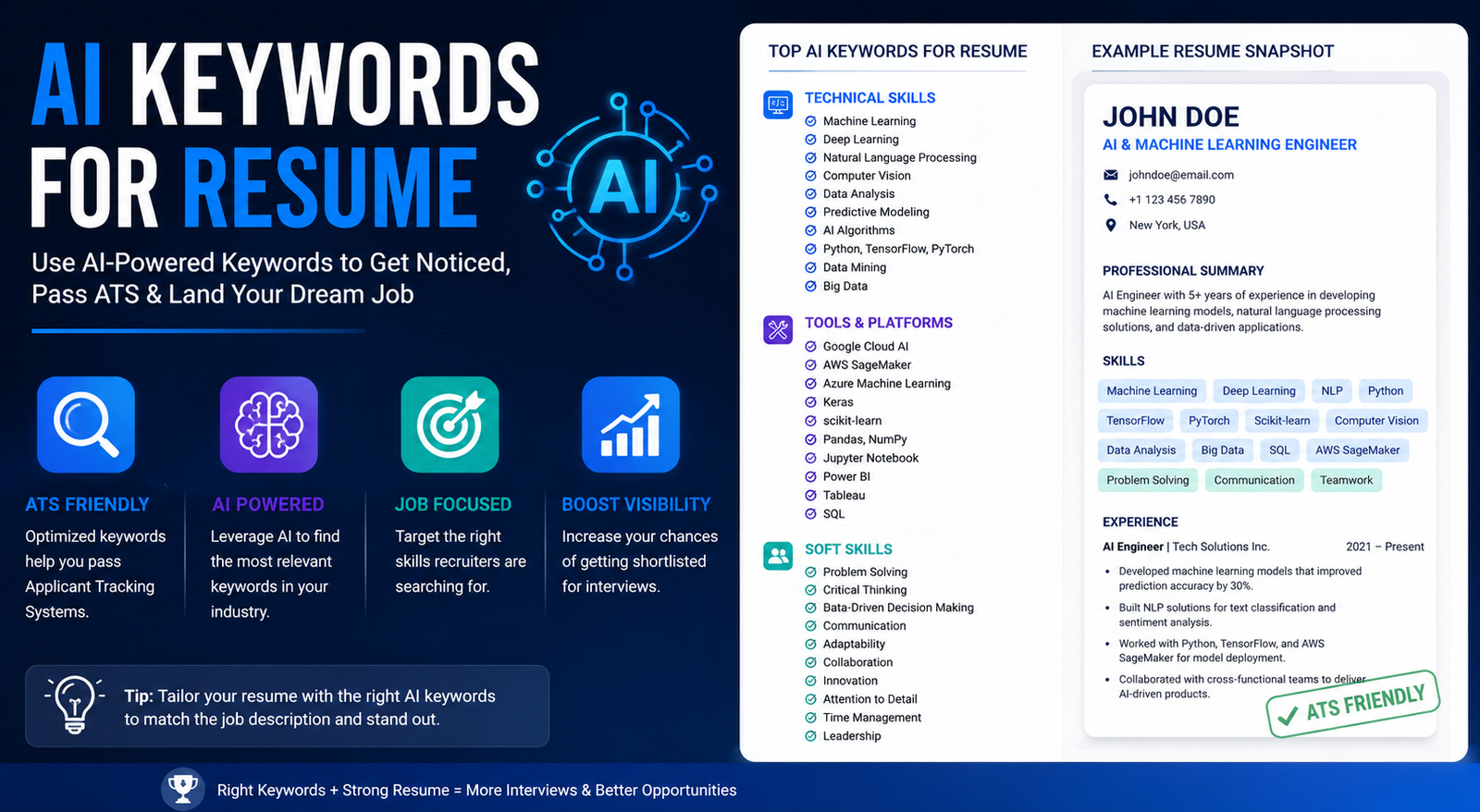
AI is changing how companies work—and it is also changing what employers look for on resumes. Whether you are applying for an AI engineering role or a marketing, HR, sales, or operations position, the right AI keywords for your resume can help communicate your skills more clearly and align your experience with a job description.
But adding “AI,” “ChatGPT,” or “machine learning” randomly is not an effective strategy. The strongest resumes use relevant keywords in context and connect them to real skills, tools, projects, and measurable results.
This guide covers the best AI resume keywords, where to use them, examples for different careers, and practical ways to tailor your resume without keyword stuffing.
What Are AI Resume Keywords?
AI resume keywords are words and phrases related to artificial intelligence, AI tools, technologies, workflows, and capabilities that employers may use in job descriptions.
They can include technical terms such as machine learning, large language models (LLMs), RAG, and natural language processing, as well as broader workplace skills such as AI automation, generative AI, AI-powered analytics, and prompt engineering.
The key is relevance. A keyword is valuable when it accurately describes something you know or have actually used.
Why AI Keywords Matter on a Resume
Many employers use applicant tracking systems (ATS) and other recruiting technologies to organize applications and identify resumes that match job requirements. That makes relevant terminology important when tailoring a resume.
However, keywords are not a shortcut to getting hired. Recruiters still need evidence that you can perform the work.
For example, compare these two statements:
Weak:
Experienced with AI and ChatGPT.
Stronger:
Used ChatGPT and prompt engineering to streamline market research and reduce weekly research time by 30%.
The second version gives the keyword context, explains how the skill was used, and provides a measurable outcome.
100+ AI Keywords for Your Resume
Use this list as a starting point. Select the terms that genuinely match your background and the position you are targeting.
Core AI Keywords
Artificial Intelligence
AI Literacy
AI Fluency
Generative AI
Machine Learning
Deep Learning
Natural Language Processing
Computer Vision
AI Integration
AI Applications
AI Strategy
AI Transformation
Predictive Modeling
Intelligent Systems
AI Solutions
Generative AI Keywords
Generative AI
Large Language Models
LLMs
Prompt Engineering
Prompt Design
Multimodal AI
AI Content Generation
AI-Assisted Research
AI-Assisted Writing
AI-Powered Search
AI Output Evaluation
AI Workflow Design
Content Automation
AI-Augmented Productivity
Advanced AI and LLM Keywords
Retrieval-Augmented Generation
RAG
AI Agents
Agentic AI
Agentic Workflows
LLM Integration
Embeddings
Semantic Search
Vector Databases
Fine-Tuning
Model Evaluation
Function Calling
Structured Outputs
Context Management
AI Guardrails
Model Monitoring
AI Automation Keywords
AI Automation
Workflow Automation
Intelligent Automation
Process Automation
Automated Workflows
AI Integration
AI Agents
Workflow Optimization
Automation Strategy
AI-Assisted Operations
Robotic Process Automation
No-Code AI Automation
AI Data and Analytics Keywords
AI-Powered Analytics
Predictive Analytics
Data Analytics
Data Modeling
Data Storytelling
Machine Learning Analytics
Synthetic Data
Data Visualization
AI-Driven Decision-Making
Predictive Modeling
Business Intelligence
Automated Reporting
Forecasting
Data Mining
AI Governance and Responsible AI Keywords
AI Governance
Responsible AI
AI Ethics
AI Risk Management
AI Compliance
AI Safety
Human-in-the-Loop
Human-AI Collaboration
AI Output Validation
Model Governance
Data Privacy
AI Policy
AI Risk Assessment
AI Tools to Put on a Resume
AI tools can be useful resume keywords when you have meaningful experience using them.
Avoid listing every AI platform you have tried. Instead, prioritize tools that are relevant to the job and explain what you accomplished with them.
For example:
AI Tools: ChatGPT, Claude, Microsoft Copilot, Zapier
is less persuasive than:
Automated recurring reporting workflows using Microsoft Copilot and Zapier, reducing manual reporting tasks by 8 hours per month.
Best AI Keywords by Job Role
The best AI keyword depends heavily on the position you are applying for.
AI Keywords for Software Engineers
Consider:
Python
Machine Learning
LLM Integration
RAG
AI Agents
Vector Databases
Fine-Tuning
Model Evaluation
LangChain
API Integration
Natural Language Processing
Deep Learning
Example:
Developed an LLM-powered RAG application that enabled employees to retrieve information from internal documentation through natural-language queries.
AI Keywords for Data Analysts
Useful terms include:
AI-Powered Analytics
Predictive Analytics
Machine Learning
Data Modeling
SQL
Data Visualization
Forecasting
Automated Reporting
Business Intelligence
Data Storytelling
Example:
Used predictive analytics and automated reporting to identify customer trends and improve monthly forecasting.
AI Keywords for Marketing Resumes
Marketing professionals can use:
Generative AI
Prompt Engineering
AI Content Optimization
AI-Assisted Research
Marketing Automation
Personalization
Predictive Analytics
AI-Powered Analytics
Workflow Automation
Example:
Applied prompt engineering and generative AI to accelerate campaign research and content ideation, reducing planning time by 30%.
AI Keywords for HR Resumes
Relevant terms include:
AI Recruiting
People Analytics
AI-Assisted Screening
Responsible AI
AI Governance
Talent Analytics
Human-in-the-Loop
AI Policy
Data Privacy
Example:
Supported AI-assisted recruiting workflows while maintaining human review and validation throughout candidate screening.
AI Keywords for Project Managers
Consider:
AI Project Management
AI Adoption
Workflow Automation
Process Optimization
AI Strategy
AI Governance
Cross-Functional AI Collaboration
Automation Strategy
Example:
Led the adoption of AI-powered workflow automation across three teams, reducing repetitive administrative work and improving project visibility.
AI Keywords for Non-Technical Professionals
You do not need to be an AI engineer to demonstrate AI skills.
Useful terms include:
AI Literacy
Generative AI
AI-Assisted Research
AI Workflow Optimization
AI Automation
Human-AI Collaboration
AI Output Validation
AI-Powered Productivity
Prompt Engineering
For non-technical candidates, focus on how AI improved your existing work, rather than pretending to have advanced technical expertise.
AI Skills vs. AI Tools vs. AI Keywords
These terms overlap, but they are not identical.
An AI skill describes what you can do. A tool describes the technology you use. An AI concept describes knowledge of a particular technology or approach.
For example:
Skill: Prompt Engineering
Tool: ChatGPT
Concept: Generative AI
Application: Automated content research
Combining these elements makes your resume more specific and credible.
How to Find the Right AI Keywords From a Job Description
Instead of copying a generic list, customize your resume for every relevant position.
Step 1: Read the job description
Identify technical skills, tools, responsibilities, and qualifications.
Step 2: Highlight AI-related terms
Look for phrases such as “generative AI,” “automation,” “machine learning,” “AI analytics,” or specific AI platforms.
Step 3: Separate required and preferred skills
Required qualifications should generally receive greater attention than optional skills.
Step 4: Compare the keywords with your experience
Only select keywords you can genuinely support.
Step 5: Add them naturally
Use important terms in your summary, skills section, projects, and work experience where appropriate.
Step 6: Turn keywords into evidence
Instead of writing:
AI Automation
write:
Automated recurring customer-reporting workflows using AI tools, reducing manual processing time by 40%.
This approach makes the keyword meaningful instead of decorative.
Where Should You Put AI Keywords on Your Resume?
Professional Summary
Use two or three of your strongest relevant AI terms.
Example:
Marketing specialist with experience in generative AI, prompt engineering, marketing automation, and AI-powered analytics.
Skills Section
Create an AI-related skills subsection when the role requires it.
Example:
AI Skills: Generative AI, Prompt Engineering, AI Automation, AI-Powered Analytics, Microsoft Copilot
Work Experience
This is where you should demonstrate how you applied the skills.
Whenever possible, include an action and measurable result.
Projects
Projects are especially valuable for students, recent graduates, and career changers.
For example:
Built a RAG-based chatbot that retrieved answers from a custom knowledge base using vector search.
Certifications and Education
Add relevant AI certifications, coursework, or projects if they are legitimate and relevant to the target role.
How to Use AI Keywords Without Keyword Stuffing
Repeating a keyword dozens of times will not make a resume stronger.
Consider:
Poor:
AI, AI tools, AI automation, ChatGPT, generative AI, AI analytics, AI skills, AI technology.
Better:
Automated weekly performance reporting using Microsoft Copilot, reducing manual analysis time by 25%.
The second example contains relevant terminology while showing actual experience.
A useful formula is:
AI keyword + action + tool or method + measurable result
For example:
Used prompt engineering with ChatGPT to automate research workflows, reducing research time by 35%.
AI Resume Keywords by Experience Level
Entry-Level Candidates
Focus on skills demonstrated through:
Academic projects
Internships
Personal projects
Certifications
Coursework
Useful keywords include Generative AI, AI Literacy, Prompt Engineering, Machine Learning, Data Analytics, and AI Projects.
Mid-Level Professionals
Show how AI improved existing business processes.
Useful terms include AI Automation, AI Integration, Workflow Optimization, AI Analytics, and AI-Assisted Operations.
Senior Professionals
Emphasize strategy, leadership, governance, and business outcomes.
Relevant keywords include:
AI Strategy
AI Transformation
AI Governance
Responsible AI
AI Adoption
AI Program Management
AI Risk Management
AI Resume Keyword Examples: Bad vs. Better
The stronger versions explain what you actually did.
Common AI Resume Keyword Mistakes
Avoid these common problems:
Adding AI skills you cannot explain in an interview.
Copying every keyword from a job posting.
Repeating “AI” excessively.
Using vague claims such as “AI guru” or “AI expert.”
Listing tools without demonstrating experience.
Putting all AI skills only in the Skills section.
Ignoring measurable achievements.
Using outdated terminology when newer terminology is relevant.
Claiming technical AI experience without evidence.
Using complicated formatting that can make a resume harder to parse.
Your resume should remain readable to both recruiting technology and human reviewers.
AI Keywords You Should Not Put on Your Resume
Avoid unsupported buzzwords such as:
AI Guru
AI Ninja
AI Genius
AI Master
AI Visionary
ChatGPT Expert
These phrases say little about your actual abilities.
A specific achievement is much stronger:
Used generative AI and structured prompting to reduce content research time by 40%.
How to Use an AI Resume Keyword Generator
An AI resume keyword generator can help identify relevant terminology from a job description, but treat its recommendations as suggestions rather than facts.
A practical workflow is:
Paste the job description into the tool.
Extract important AI skills and technologies.
Separate required from preferred keywords.
Compare them with your current resume.
Keep only keywords supported by your experience.
Rewrite relevant bullets with specific evidence.
Review the final resume yourself.
A useful prompt is:
“Analyze this job description and identify the most important AI-related skills, technologies, tools, and phrases. Separate required and preferred keywords. Then compare them with my resume and identify only the keywords I can truthfully support.”
AI Resume Keyword Checklist
Before submitting your resume, check:
Did I match my resume to the specific job?
Did I identify the most important AI skills?
Did I include relevant AI tools?
Are my AI keywords supported by real experience?
Did I include important terms in my work experience?
Did I quantify results where possible?
Did I avoid keyword stuffing?
Did I avoid unsupported AI claims?
Is the resume easy to read?
Does every AI keyword make sense for the target position?
FAQs About AI Keywords for Resumes
What are the best AI keywords for a resume?
Some strong AI resume keywords include Generative AI, Prompt Engineering, Machine Learning, Large Language Models, AI Automation, AI Agents, RAG, AI-Powered Analytics, Responsible AI, and Human-in-the-Loop. Choose terms based on the job and your actual experience.
Is ChatGPT a good resume keyword?
Yes, when it is relevant and you have meaningful experience using it. Instead of simply writing “ChatGPT,” explain how you used it and what result it produced.
How do I list generative AI on my resume?
You can list Generative AI under your skills and demonstrate it in your experience or projects. For example: “Applied generative AI and prompt engineering to streamline content research.”
How many AI keywords should I put on my resume?
There is no universal ideal number. Prioritize the most relevant keywords from the job description and use them naturally throughout your resume rather than trying to reach a specific keyword count.
Should AI tools go in the Skills section?
They can, especially when the tool is directly relevant to the position. However, showing how you used the tool in your work experience is generally more persuasive than simply listing its name.
Can non-technical professionals put AI skills on their resumes?
Absolutely. Marketing, HR, sales, operations, finance, customer service, and administrative professionals can highlight AI literacy, automation, research, analytics, productivity, and workflow skills when they have actually used them.
What is the best way to use AI keywords for ATS?
Match relevant terminology from the job description to genuine skills and experience on your resume. Use natural language, include important keywords in relevant sections, and avoid stuffing unrelated terms into the document.
Conclusion
The best AI keywords for a resume are not necessarily the most technical or trendy terms. They are the keywords that accurately connect your experience to what an employer needs.
Start with the job description, identify the most relevant AI skills and technologies, then demonstrate those keywords through specific accomplishments. Whether you are highlighting generative AI, prompt engineering, AI automation, machine learning, RAG, or AI-powered analytics, context matters.
A strong AI-friendly resume doesn't simply say “I know AI.” It shows how you used AI, what you accomplished, and why that experience matters to the employer.
Leave a Reply