

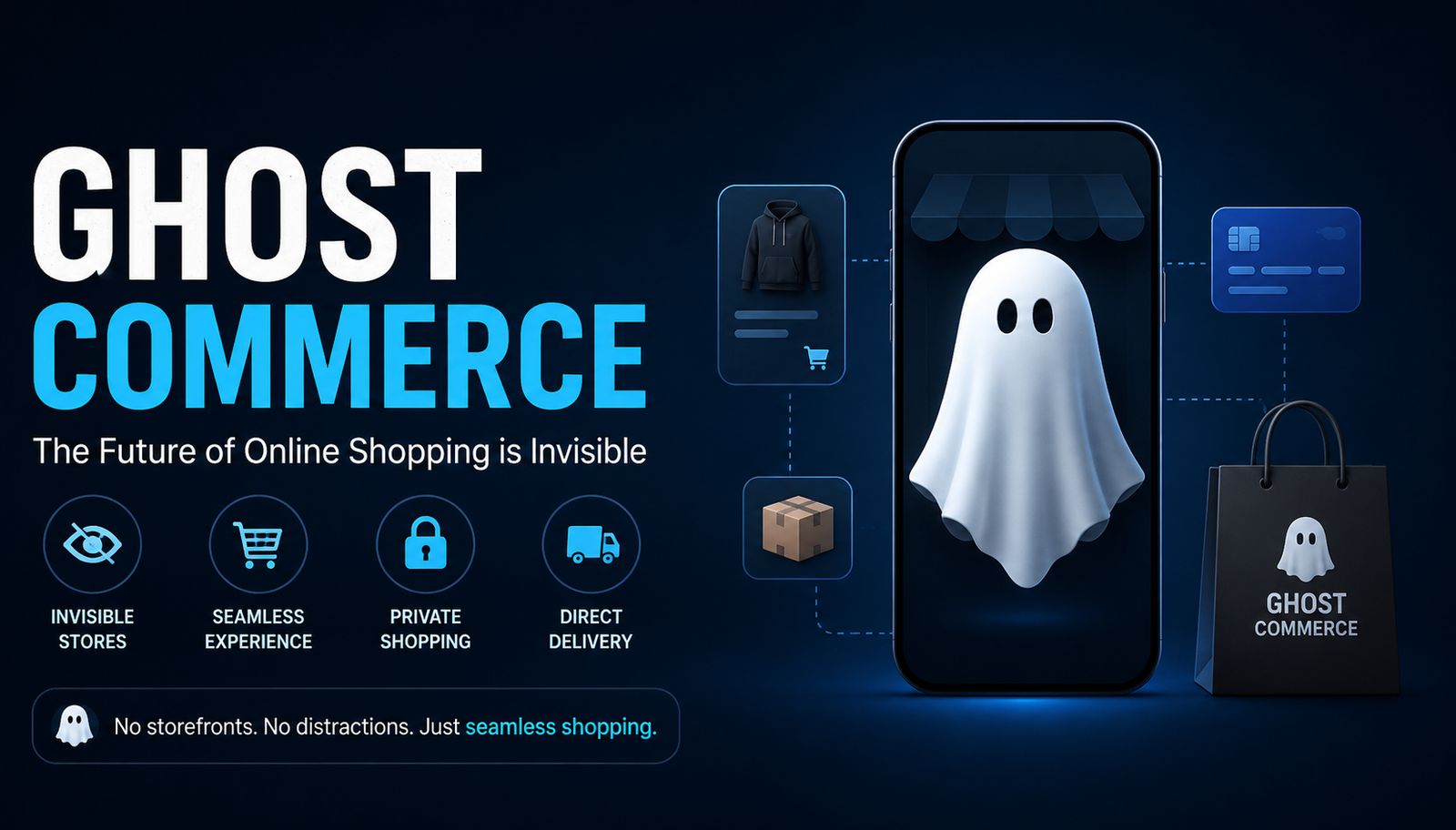
Ghost commerce is becoming a popular way to build an online business without maintaining a traditional inventory-based operation. Instead of buying products in bulk, renting warehouse space, or handling every shipment yourself, you can use digital marketing, third-party suppliers, affiliate programs, or fulfillment services to generate revenue.
But what exactly is ghost commerce, and is it really a legitimate business opportunity?
The answer depends on how the term is being used. Ghost commerce is generally a digital-first approach to selling or promoting products without personally managing physical inventory. It can include dropshipping, affiliate marketing, print-on-demand, white-label products, and other third-party fulfillment models.
This guide explains how ghost commerce works, the most common business models, startup costs, profitability, legitimate opportunities, jobs, platforms, and the steps beginners can take to get started.
What Is Ghost Commerce?
Ghost commerce is a broad ecommerce approach where the business owner focuses primarily on finding customers, creating content, building a brand, and generating sales rather than physically storing and shipping products.
The "ghost" concept comes from the fact that much of the traditional retail infrastructure can operate behind the scenes.
For example, a customer may discover a product through your website or social media page. They place an order, but a supplier or fulfillment company handles inventory and shipping. In an affiliate model, the customer may even purchase directly from another company while you earn a commission for referring them.
This makes ghost commerce attractive to entrepreneurs who want a lower-overhead online business.
How Does Ghost Commerce Work?
A typical ghost commerce process looks like this:
Choose a niche → Find a product or offer → Build an online presence → Attract visitors → Generate sales → Third party fulfills the order or pays a commission → Analyze and improve performance
The exact process depends on the business model.
For example, a dropshipping store may earn a product margin, while an affiliate website earns commissions. A print-on-demand business can sell custom products without keeping finished products in stock.
Main Types of Ghost Commerce
Ghost commerce is not one specific platform or technology. It can describe several business models that reduce the need for traditional inventory management.
Affiliate Marketing
Affiliate marketing involves promoting another company's product or service using a special tracking link. When someone makes a qualifying purchase, the affiliate receives a commission.
This model is particularly suitable for bloggers, SEO professionals, YouTubers, influencers, and content creators.
Dropshipping
With dropshipping, you operate the storefront and market products while a supplier stores and ships the products to customers.
You generally earn the difference between the amount the customer pays and the costs associated with the product and fulfillment.
Print-on-Demand
Print-on-demand allows you to create designs for products such as shirts, mugs, posters, and accessories.
A customer places an order, and the print-on-demand provider produces and ships it. You don't need to maintain an inventory of finished products.
White Labeling
White labeling involves selling an existing product under your own brand.
A manufacturer handles production while you focus on branding, marketing, distribution, and customer acquisition.
Digital Products
Digital products can also fit into a broader ghost commerce strategy. Examples include ebooks, templates, online courses, graphics, software, and downloadable resources.
Because there is no physical inventory, digital products can have very different economics from physical ecommerce.
Ghost Commerce vs Dropshipping
One of the biggest sources of confusion is the difference between ghost commerce vs dropshipping.
Dropshipping is a specific ecommerce fulfillment method. Ghost commerce is a broader term that can include dropshipping as well as affiliate marketing, print-on-demand, and other models.
Therefore, saying that ghost commerce and dropshipping are exactly the same would be misleading.
Is Ghost Commerce Legit?
Yes, ghost commerce can be a legitimate way to operate an online business. However, the term itself does not guarantee that a particular business opportunity is legitimate.
The biggest warning signs are promises of guaranteed income, instant passive income, fake testimonials, hidden fees, unrealistic profit screenshots, and pressure to purchase expensive programs immediately.
A legitimate business still requires market research, marketing, customer service, financial planning, and continuous optimization.
If affiliate marketing is involved, appropriate disclosures may also be required depending on the market and advertising rules that apply. Businesses should research the regulations relevant to their location and audience rather than assuming that one set of rules applies everywhere.
How to Identify a Legitimate Opportunity
Look for:
Transparent pricing
Clear refund policies
Realistic revenue claims
Genuine product information
Verifiable business details
Clear affiliate disclosures when applicable
Reliable suppliers
A clearly explained business model
The word "ghost" does not mean the business should be anonymous or unaccountable.
Is Ghost Commerce Profitable?
Ghost commerce can be profitable, but profitability is never guaranteed.
A business can generate substantial revenue and still lose money if advertising, product costs, refunds, payment fees, software, and other expenses are too high.
A simple calculation is:
Revenue − product costs − advertising − payment fees − software − refunds − other expenses = profit
For example, imagine a hypothetical store generates $5,000 in monthly sales.
If product and fulfillment costs total $2,500, advertising costs $800, payment and software costs total $300, and refunds and miscellaneous expenses reach $200, the remaining amount would be approximately $1,200 before taxes and other business expenses.
This is only an example, not an expected result.
What Determines Profitability?
Several factors affect the outcome:
Product margins
Customer acquisition cost
Conversion rate
Average order value
Repeat purchases
Advertising performance
Supplier pricing
Refund rates
Organic traffic
Operating expenses
A product with a high selling price isn't automatically profitable. The real question is how much profit remains after all costs are deducted.
How Much Does It Cost to Start Ghost Commerce?
One advantage of ghost commerce is that you can potentially start with less capital than a traditional inventory-heavy business.
However, "low cost" does not mean "free."
Typical expenses can include:
These are illustrative ranges rather than guaranteed prices.
Someone using SEO and organic social media may spend very little money on advertising but invest significantly more time. Someone using paid advertising can potentially launch faster but takes on greater financial risk.
How to Start a Ghost Commerce Business
1. Choose a Specific Niche
Don't start by choosing a random product.
Look for a niche with clear demand, commercial intent, manageable competition, and enough products or offers to build around.
Potential areas include beauty, fitness, hobbies, home products, technology accessories, pets, education, and lifestyle.
2. Research Products and Offers
Evaluate:
Demand
Competition
Selling price
Potential margin
Reviews
Shipping times
Supplier reliability
Repeat-purchase potential
Avoid selecting products solely because they are trending on social media.
3. Choose Your Business Model
Decide whether affiliate marketing, dropshipping, print-on-demand, white labeling, digital products, or another approach makes the most sense.
Your choice should depend on your skills, available budget, audience, and desired level of control.
4. Find Reliable Partners
If you're selling physical products, research suppliers carefully.
Check their:
Product quality
Customer reviews
Communication
Shipping speed
Return policies
Tracking
Pricing
Inventory reliability
Ordering a sample before promoting a product can help you discover quality or fulfillment problems before your customers do.
5. Build Your Digital Presence
Depending on the model, you may need a website, ecommerce store, social media account, blog, YouTube channel, or another digital platform.
Focus on useful content and a trustworthy customer experience rather than simply publishing hundreds of product pages.
6. Generate Traffic
Ghost commerce depends heavily on customer acquisition.
Useful channels include:
SEO
Google search
TikTok
Instagram
YouTube
Pinterest
Email marketing
Influencer partnerships
Paid advertising
For SEO, target informational keywords first and gradually build commercial content such as product comparisons, reviews, buying guides, and "best" lists.
7. Measure and Optimize
Track metrics such as:
Traffic
Conversion rate
Customer acquisition cost
Average order value
Revenue
Profit margin
Refund rate
Don't scale an advertising campaign simply because sales are increasing. Make sure the underlying economics are sustainable.
Ghost Commerce Platforms
There is no single platform that defines ghost commerce.
Depending on the model, entrepreneurs may use:
Ecommerce platforms for online stores
Affiliate networks for referral programs
Print-on-demand platforms for customized products
Supplier marketplaces for product sourcing
Website builders for content sites
Email marketing platforms for customer retention
Analytics tools for performance measurement
When evaluating ghost commerce platforms, consider transaction fees, integrations, payment options, customization, supplier compatibility, analytics, and scalability.
The best platform is the one that supports your chosen business model rather than the one with the most features.
Ghost Commerce Jobs and Work From Home Opportunities
Ghost commerce can also create work-from-home opportunities, although these are not necessarily traditional "ghost commerce jobs."
Potential roles include:
Ecommerce manager
Product researcher
SEO specialist
Content writer
Affiliate marketer
Social media manager
Customer support specialist
Email marketing specialist
Paid advertising manager
Virtual assistant
Ecommerce store manager
For someone searching for ghost commerce jobs work from home, it is important to distinguish legitimate employment from business opportunities.
A job should clearly explain the employer, responsibilities, compensation, and hiring process. Be cautious of opportunities that require large upfront payments or promise guaranteed income for minimal work.
Can You Learn Ghost Commerce Through a Course?
A ghost commerce course can be useful for beginners who want structured guidance, but a course should not be treated as a guarantee of business success.
A good course should teach practical skills such as:
Niche research
Product validation
Supplier evaluation
Store setup
SEO
Content marketing
Advertising
Analytics
Customer service
Profit calculation
Before purchasing a course, review the curriculum, instructor credentials, refund policy, independent reviews, and actual learning outcomes.
Ghost Commerce Example
Consider a simple hypothetical example.
A creator builds a website around home organization. Instead of purchasing hundreds of storage products, they publish helpful articles comparing products and explaining how to organize small spaces.
They could monetize the audience through affiliate links. Alternatively, they could create a store using a supplier that handles fulfillment.
The creator's primary responsibility is attracting relevant visitors and providing useful information. The supplier or merchant handles the physical side of the transaction, depending on the selected model.
This demonstrates why content, SEO, product research, and customer trust can be more important than owning a warehouse.
Common Ghost Commerce Mistakes
Choosing products without research
A viral product isn't necessarily a sustainable business opportunity.
Expecting passive income
Automation can reduce repetitive tasks, but ghost commerce still requires marketing, optimization, customer support, and decision-making.
Ignoring supplier quality
A supplier problem eventually becomes a customer problem.
Copying product descriptions
Original, useful content is better for both customers and search engines than duplicated supplier text.
Scaling too quickly
Prove that a product, offer, traffic source, and conversion process work before aggressively increasing spending.
Frequently Asked Questions
What is ghost commerce?
Ghost commerce is a broad digital-first approach to selling or promoting products without personally maintaining traditional physical inventory. It can include models such as dropshipping, affiliate marketing, print-on-demand, and white labeling.
Is ghost commerce legit?
Yes. Ghost commerce can be legitimate, but individual opportunities vary. Avoid businesses promising guaranteed income, instant wealth, or completely passive earnings.
Is ghost commerce profitable?
It can be profitable, but results depend on product margins, customer acquisition costs, conversion rates, traffic, refunds, supplier costs, and operating expenses.
Is ghost commerce the same as dropshipping?
No. Dropshipping is one specific ecommerce model where a supplier fulfills orders. Ghost commerce is a broader term that can include dropshipping and other models.
Can I start ghost commerce from home?
Yes. Many ghost commerce models can be operated remotely using a website, social media, affiliate programs, suppliers, and third-party fulfillment services.
Do I need a website for ghost commerce?
Not always. Affiliate marketers and social media creators can operate without their own ecommerce store. However, a website can provide greater control over branding, SEO, content, and customer acquisition.
Is ghost commerce passive income?
Not automatically. Automation can handle some repetitive processes, but successful businesses still require marketing, product research, customer support, optimization, and financial management.
Conclusion
Ghost commerce provides a flexible way to participate in online commerce without building a traditional inventory-heavy operation. Depending on your strategy, you can use affiliate marketing, dropshipping, print-on-demand, white labeling, or digital products.
The biggest advantage is flexibility. The biggest misconception is that flexibility means effortless income.
A successful ghost commerce business still depends on choosing the right niche, validating products, working with reliable partners, creating useful content, attracting qualified traffic, and carefully monitoring profitability.
If you're considering starting, begin small. Pick one niche, validate one business model, test your offer, measure the results, and scale only after the numbers make sense.
Leave a Reply