

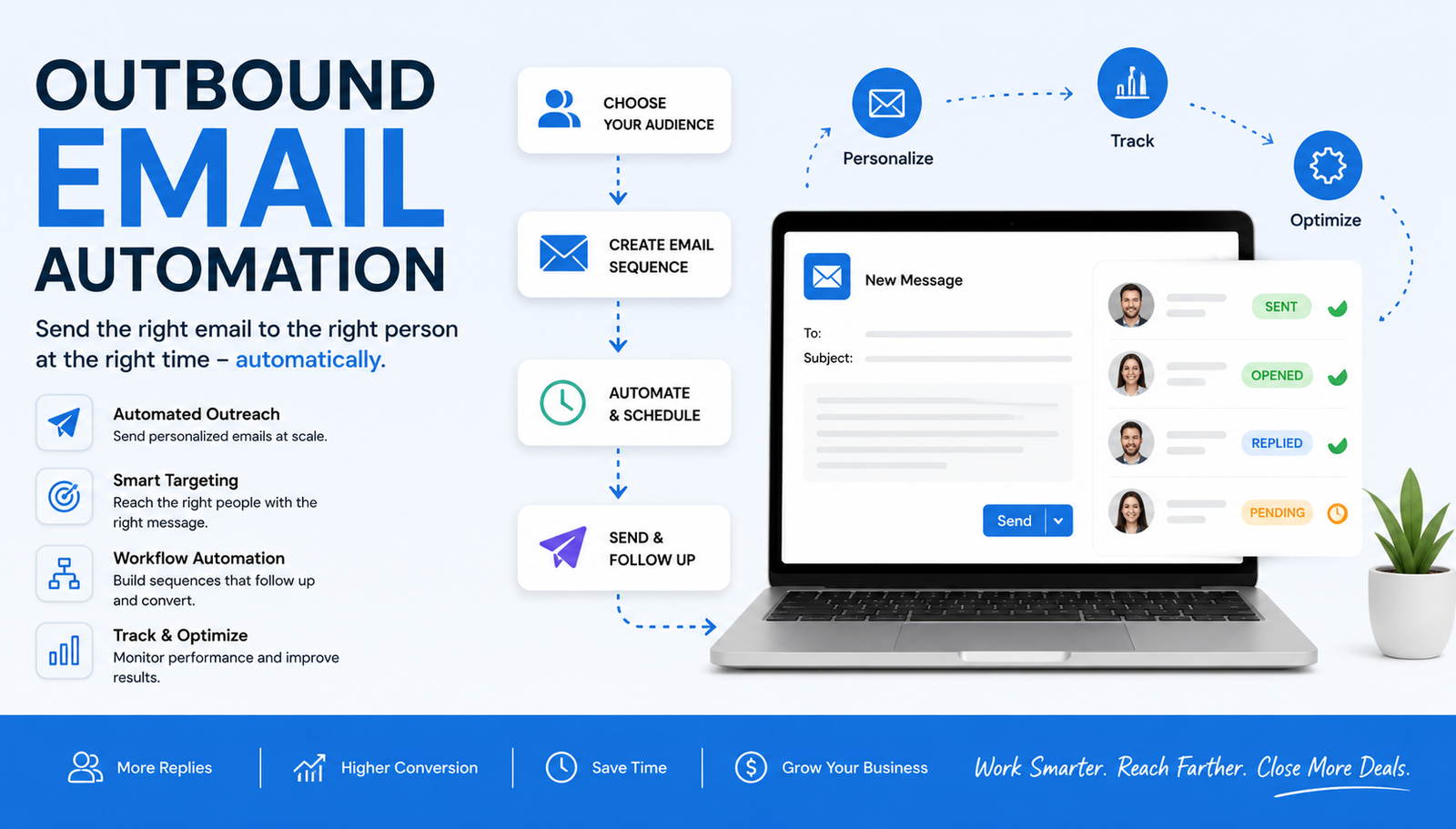
In modern B2B sales, sending hundreds of emails manually is no longer practical. Buyers expect relevant, personalized communication, while sales teams need efficient ways to reach more prospects without sacrificing quality. This is where outbound email automation becomes a game changer.
Outbound email automation helps businesses streamline prospecting, automate follow-ups, personalize outreach at scale, and generate more qualified opportunities. When implemented correctly, it can significantly improve productivity while maintaining meaningful engagement with potential customers.
This guide explains how outbound email automation works, its benefits, best practices, common mistakes, and how to use it effectively to build a predictable sales pipeline.
What Is Outbound Email Automation?
Outbound email automation is the process of using software to send, schedule, personalize, and manage outreach emails to prospects automatically.
Instead of manually tracking every lead and follow-up, businesses create automated workflows that trigger emails based on predefined actions, schedules, or prospect behavior.
For example, if a prospect doesn't respond to the first email, the system can automatically send a follow-up three days later. This ensures consistent communication without requiring constant manual effort.
How It Differs From Traditional Cold Emailing
Traditional cold emailing often involves manually sending messages one by one, tracking responses in spreadsheets, and remembering follow-up dates.
Outbound email automation eliminates these repetitive tasks by using sequences, triggers, and integrations that manage outreach at scale while maintaining personalization.
Key Components of Outbound Email Automation
Most successful automation systems include:
Prospect databases
Email sequences
Personalization variables
Automated follow-ups
CRM integrations
Analytics dashboards
Deliverability monitoring
Why Outbound Email Automation Matters
Sales teams face increasing pressure to generate more pipeline with limited resources. Automation provides a scalable solution.
Increased Productivity
Sales representatives spend less time on administrative tasks and more time engaging with qualified prospects.
Consistent Follow-Ups
Research consistently shows that many sales opportunities are lost because follow-ups stop too early. Automation ensures no lead is forgotten.
Better Personalization at Scale
Modern tools combine prospect data with AI-powered personalization, allowing teams to create relevant messages without writing every email from scratch.
Faster Pipeline Growth
Businesses can contact larger audiences while maintaining organized outreach campaigns, resulting in more conversations and opportunities.
How Outbound Email Automation Works
The outbound email process follows a structured workflow.
Step 1: Identify Target Prospects
Start by defining your ideal customer profile (ICP). Focus on industries, company sizes, job titles, and pain points that align with your offering.
Step 2: Enrich Lead Data
Gather information such as:
Company size
Industry
Technology stack
Recent company news
Contact information
Enriched data enables stronger personalization.
Step 3: Segment Prospects
Group prospects based on common characteristics.
Examples include:
SaaS companies
Marketing agencies
Healthcare organizations
Enterprise businesses
Segmentation improves messaging relevance.
Step 4: Create Automated Sequences
Build a sequence that includes:
Initial outreach
Follow-up #1
Follow-up #2
Breakup email
Each email serves a specific purpose within the sales process.
Step 5: Analyze Results
Track campaign performance and optimize based on key metrics.
Essential Features of Outbound Email Automation Software
Not all platforms offer the same capabilities.
Email Sequence Builder
A sequence builder allows users to create multi-step outreach campaigns with automated timing.
AI Personalization
Modern platforms use artificial intelligence to generate personalized subject lines, opening sentences, and prospect-specific insights.
CRM Integration
CRM connectivity ensures all prospect interactions remain synchronized.
Analytics and Reporting
Detailed reports help teams understand:
Open rates
Reply rates
Meeting bookings
Pipeline contribution
A/B Testing
Testing different subject lines, calls to action, and email structures helps improve campaign performance.
Outbound Email Automation vs Manual Outreach
This comparison highlights why automation has become a core component of modern sales operations.
Benefits of Outbound Email Automation
Saves Valuable Time
Automation removes repetitive tasks like scheduling emails and tracking follow-ups.
Improves Lead Engagement
Prospects receive timely communication based on their actions and engagement levels.
Increases Meeting Bookings
Consistent outreach typically results in more responses and booked meetings.
Creates Predictable Revenue Opportunities
A structured process helps generate a steady flow of qualified leads.
Supports Team Growth
Sales teams can scale outreach without significantly increasing headcount.
The Role of AI in Outbound Email Automation
Artificial intelligence is transforming how businesses approach outreach.
AI-Powered Personalization
AI can analyze prospect information and generate customized messaging that feels more relevant.
Lead Scoring
Machine learning helps identify prospects most likely to engage.
Reply Classification
AI can categorize incoming responses into:
Interested
Not interested
Meeting request
Out of office
This reduces manual workload.
Prospect Research
AI tools can gather information from public sources to support personalized outreach strategies.
Human Oversight Still Matters
While AI improves efficiency, human review remains essential for maintaining authenticity and relationship building.
Building a High-Converting Outbound Email Strategy
Technology alone won't guarantee results.
Define Your Ideal Customer Profile
Understanding who benefits most from your solution is critical.
Questions to consider:
Who experiences the problem?
Which industries are most suitable?
Who makes purchasing decisions?
Create Relevant Segments
Avoid sending the same email to every prospect.
Different audiences require different messaging.
Focus on Value
Rather than discussing your product immediately, address the prospect's challenges and goals.
Use Effective Follow-Ups
Many responses occur after multiple touchpoints.
An effective sequence typically includes three to five follow-ups.
Email Deliverability: The Foundation of Success
One of the biggest content gaps in many discussions about outbound email automation is deliverability.
Even the best email won't generate results if it lands in spam.
What Is Email Deliverability?
Deliverability refers to the ability of emails to reach the recipient's inbox successfully.
Common Causes of Spam Placement
Poor domain reputation
High bounce rates
Excessive sending volume
Missing authentication records
Spam-like content
Email Warm-Up
New domains should gradually increase sending volume to establish credibility with mailbox providers.
Monitor Bounce Rates
High bounce rates can damage sender reputation and reduce future deliverability.
Email Authentication Essentials
Proper authentication helps prove that emails are legitimate.
SPF
SPF verifies which servers can send emails on behalf of your domain.
DKIM
DKIM adds a digital signature that validates message integrity.
DMARC
DMARC provides instructions for handling authentication failures and strengthens domain protection.
Together, these technologies improve inbox placement and reduce spam risks.
Legal Compliance for Outbound Email Automation
Compliance is an important consideration for every business.
GDPR
Organizations targeting European audiences must comply with GDPR requirements regarding personal data.
CAN-SPAM
Businesses operating in the United States must follow CAN-SPAM regulations.
CASL
Canadian outreach campaigns may require compliance with CASL guidelines.
Best Practices
Always:
Include business identification
Provide unsubscribe options
Maintain accurate sender information
Respect privacy regulations
Best Use Cases for Outbound Email Automation
SaaS Lead Generation
Software companies use automation to connect with decision-makers and generate demos.
Agency Client Acquisition
Marketing agencies can automate outreach to potential clients while maintaining personalization.
Recruitment
Recruiters can engage candidates efficiently through targeted sequences.
Partnership Development
Businesses often use automation to establish strategic partnerships.
Event Follow-Ups
Attendees can receive personalized follow-up messages after conferences and webinars.
Common Mistakes to Avoid
Over-Automation
Excessive automation can make emails feel robotic.
Poor Prospect Data
Bad data results in irrelevant messaging and low engagement.
Weak Personalization
Generic outreach rarely generates strong response rates.
Ignoring Deliverability
Many campaigns fail because inbox placement issues go unnoticed.
Sending Too Many Emails
Aggressive outreach can harm reputation and increase unsubscribe rates.
Metrics That Measure Success
Tracking the right KPIs is essential.
Open Rate
Indicates subject line effectiveness and deliverability.
Reply Rate
Measures prospect engagement.
Positive Reply Rate
Shows how many responses indicate genuine interest.
Meeting Booking Rate
Tracks conversion from outreach to scheduled meetings.
Pipeline Contribution
Measures the value generated through automated campaigns.
Revenue Attribution
Connects outreach activities to actual revenue outcomes.
Choosing the Right Platform
Businesses evaluating solutions often compare features, pricing, and scalability.
Some teams search for Cold email automation free options when starting out, while others prioritize advanced enterprise capabilities.
Companies with limited budgets may look for the Cheapest cold email software, but cost should never be the only factor. Deliverability, automation capabilities, and support often have a greater impact on long-term results.
When comparing the Best email outreach tools, consider:
Deliverability features
AI personalization
CRM integrations
Reporting capabilities
Ease of use
Scalability
The right platform should support your current needs while allowing future growth.
Future Trends in Outbound Email Automation
The industry continues evolving rapidly.
Key trends include:
AI-powered sales agents
Intent-based prospecting
Predictive lead scoring
Hyper-personalization
Multi-channel outreach
Advanced revenue attribution
Businesses that adapt to these developments will gain significant competitive advantages.
Conclusion
Outbound email automation has become an essential component of modern sales and lead generation strategies. It enables businesses to scale outreach, improve consistency, increase productivity, and generate more qualified opportunities without overwhelming sales teams.
Success, however, requires more than simply automating emails. High-quality prospect data, thoughtful personalization, strong deliverability practices, legal compliance, and continuous optimization all play critical roles. Organizations that combine automation with a human-centered approach can build stronger relationships, improve response rates, and create sustainable pipeline growth.
Frequently Asked Questions
What is outbound email automation?
Outbound email automation is the use of software to automate prospecting emails, follow-ups, personalization, and campaign management for sales and lead generation purposes.
Is outbound email automation legal?
Yes, outbound email automation is legal when businesses comply with regulations such as GDPR, CAN-SPAM, and CASL.
How many emails should I send per day?
The ideal volume depends on domain reputation, email warm-up status, and provider guidelines. Gradual scaling is generally recommended.
How can I improve email deliverability?
Implement SPF, DKIM, and DMARC records, warm up domains properly, maintain list quality, and monitor bounce rates.
What is the difference between cold email and outbound email automation?
Cold email refers to outreach itself, while outbound email automation refers to the technology and workflows used to automate and scale that outreach.
Can AI improve outbound email campaigns?
Yes. AI can assist with personalization, lead scoring, prospect research, and reply classification, helping teams operate more efficiently.
What metrics matter most for outbound email automation?
Reply rate, positive reply rate, meeting booking rate, pipeline contribution, and revenue attribution are among the most valuable performance metrics.
Leave a Reply