

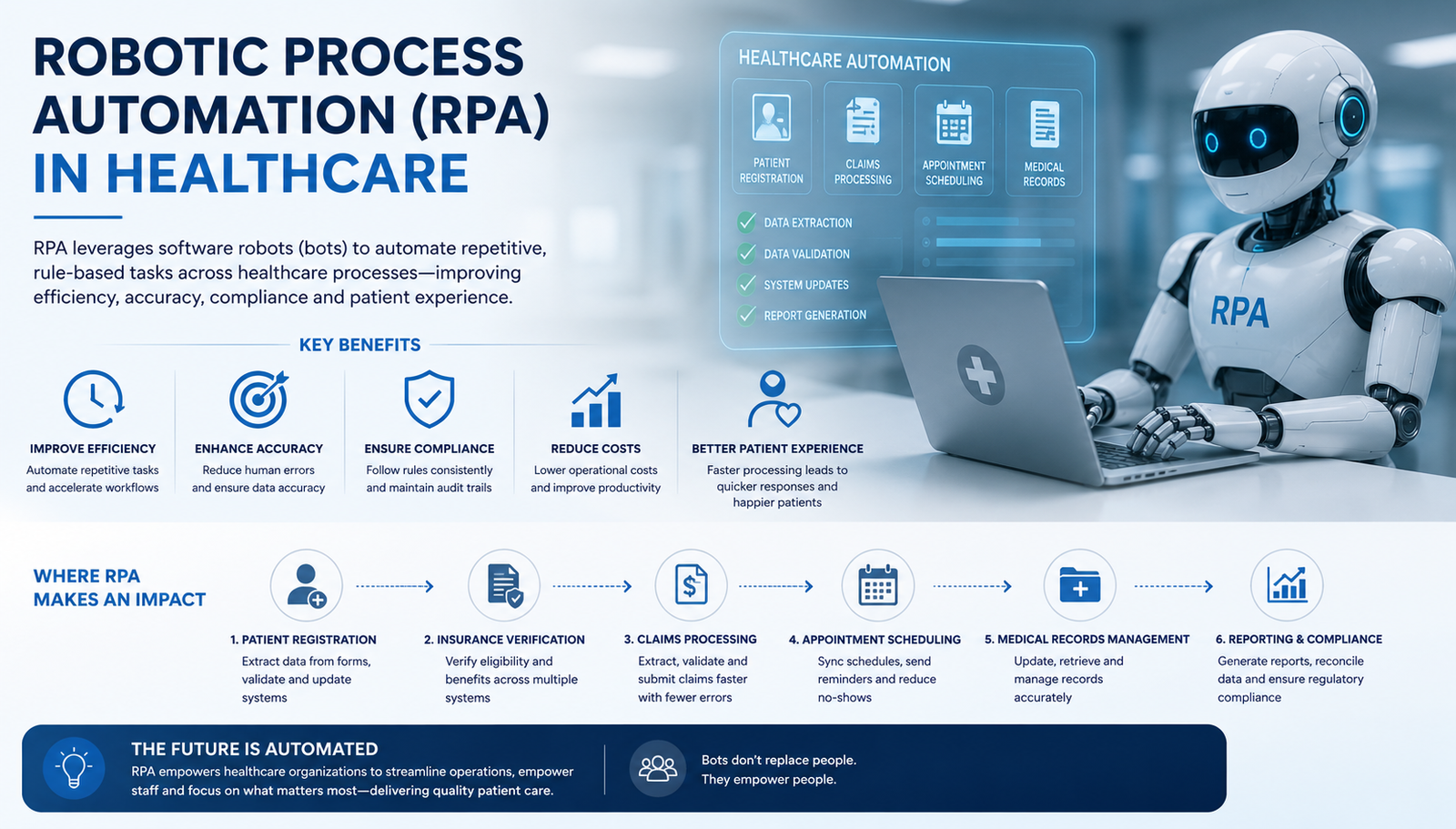
Healthcare organizations manage thousands of repetitive administrative tasks every day. Staff members verify insurance coverage, update patient records, submit claims, schedule appointments, prepare reports, and transfer information between disconnected systems. These activities are essential, but they consume time that could be spent improving patient care.
Robotic process automation in healthcare offers a practical way to reduce this administrative pressure. RPA uses software bots to perform structured, rules-based digital tasks in the same way a human employee would. A bot can log into applications, enter information, download documents, check claim statuses, send notifications, and update records without requiring major changes to existing healthcare systems.
RPA is not designed to replace doctors, nurses, or clinical judgment. Its main purpose is to automate predictable administrative workflows, reduce human error, improve efficiency, and help healthcare professionals focus on higher-value responsibilities.
What Is Robotic Process Automation in Healthcare?
Robotic process automation, commonly called RPA, is a technology that uses software bots to complete repetitive computer-based tasks. These bots interact with websites, electronic health record systems, billing platforms, email tools, spreadsheets, and payer portals.
When people ask, “What does RPA stand for in healthcare?” the answer is usually robotic process automation. However, the term RPA can have different meanings in medical contexts. An RPA medical professional may refer to a registered physician assistant in some regions, while searches for an RPA medical degree may relate to physician assistant education rather than automation technology.
In healthcare technology, the RPA meaning refers to software-driven process automation.
A healthcare RPA bot may perform actions such as:
Logging into a payer portal
Checking insurance eligibility
Transferring patient information
Sending appointment reminders
Updating billing records
Downloading claims reports
Identifying missing information
Creating audit logs
The bot follows predefined rules. When it encounters incomplete, unusual, or sensitive information, it can send the case to a human employee for review.
How Does Healthcare RPA Work?
A typical RPA workflow begins with a trigger. The trigger may be a newly submitted patient form, an incoming email, a scheduled time, or an updated claim status.
The bot then follows a predefined sequence:
It accesses the authorized application.
It retrieves the required information.
It validates the data against business rules.
It updates another system or completes a task.
It records the activity.
It sends exceptions to a staff member.
For example, an insurance-verification bot may retrieve a patient’s policy number from an appointment system, log into the insurer’s portal, confirm coverage, collect deductible information, and update the patient account.
This process may take only a few minutes and can run repeatedly without requiring staff members to perform the same steps manually.
Attended vs. Unattended RPA
Healthcare organizations can use different types of bots depending on the workflow.
Attended bots assist employees during active work. Unattended bots complete scheduled or high-volume tasks independently. Hybrid automation is especially useful in healthcare because sensitive decisions often require human oversight.
Why Healthcare Organizations Are Adopting RPA
Healthcare systems often depend on multiple applications that do not communicate effectively. Employees may need to copy information from an EHR into a billing platform, insurer portal, CRM, or reporting system.
This creates several problems:
Repetitive administrative work
Increased risk of data-entry errors
Slow reimbursement
Employee burnout
Missed appointments
Claim-processing delays
Inconsistent reporting
High operating costs
RPA helps connect these workflows without requiring every legacy platform to be replaced. Because bots can operate through existing user interfaces, organizations can automate tasks even when a modern API is unavailable.
Benefits of Robotic Process Automation in Healthcare
Reduced Administrative Workload
RPA can take over repetitive activities such as copying patient data, checking claim statuses, generating reports, and sending reminders.
This allows administrative employees to focus on complex cases, patient communication, and problem resolution.
Faster Claims and Billing Processes
Bots can validate claims, check required fields, submit information, monitor payer portals, and identify denials.
Faster processing may improve cash flow and reduce the time between service delivery and reimbursement.
Improved Data Accuracy
Manual data entry can result in misspellings, duplicate records, missing fields, and incorrect codes. RPA follows standardized rules, which can reduce routine processing errors.
Human review is still necessary for exceptions and clinical information.
Lower Operating Costs
Healthcare RPA can reduce labor hours spent on repetitive work, limit rework, and improve employee capacity.
Savings depend on process volume, bot-maintenance costs, licensing, and implementation quality. RPA should not be promoted as a guaranteed cost-cutting solution without measuring the existing workflow.
Better Patient Experience
Administrative delays directly affect patients. Automation can support faster appointment confirmation, fewer billing mistakes, quicker insurance checks, and more consistent communication.
When staff members spend less time on repetitive data entry, they may have more time to support patients.
Improved Compliance and Auditability
Bots can follow predefined procedures and create activity logs for each action.
However, automation does not automatically make a workflow compliant. Access controls, security monitoring, documentation, and human governance are still required.
Robotic Process Automation in Healthcare Examples
Appointment Scheduling
RPA can support appointment creation, confirmations, cancellations, reminders, and waitlist management.
For example, a bot can receive an online appointment request, check available time slots, update the scheduling platform, and send a confirmation message.
Patient Registration
Bots can transfer demographic details, insurance information, and contact data from online forms into hospital systems.
They may also identify missing fields or possible duplicate records before onboarding is completed.
Insurance Eligibility Verification
Insurance checks are among the most common robotic process automation in healthcare examples.
A bot can log into a payer portal, enter patient details, verify coverage, retrieve deductible information, and update the billing system.
Cases with inactive coverage or unclear policy details can be assigned to staff.
Claims Processing
RPA can help validate claim information, submit claims, monitor status updates, and identify rejected submissions.
It may also categorize denials and prepare cases for employee review.
Medical Billing
RPA can automate charge entry, payment posting, account reconciliation, and outstanding balance reports.
Medical coding and unusual billing decisions should remain under the supervision of qualified professionals.
Prior Authorization
Bots can gather documents, populate forms, check payer requirements, upload records, and monitor authorization status.
Because prior authorization may involve clinical information, human review should remain part of the process.
EHR Data Management
RPA can assist with record updates, report generation, data migration, and synchronization between healthcare platforms.
Bots may be useful when systems lack reliable direct integrations.
Regulatory Reporting
Healthcare organizations can use bots to collect information from multiple systems, organize it into required formats, and identify missing records.
This can improve reporting consistency, but compliance teams should still validate the final submission.
Patient Communication
RPA can support appointment reminders, form-completion requests, billing notifications, and discharge follow-up messages.
Bots should not be used to provide independent medical advice or replace conversations with qualified healthcare professionals.
Hospital IT Monitoring
A less common but valuable use case involves bots that simulate user activity inside an electronic medical record system.
These bots can open screens, perform searches, and measure response times. This may help IT teams identify delays or system failures that infrastructure monitoring tools do not detect.
RPA vs. AI, APIs, and Workflow Automation
RPA is often grouped with artificial intelligence, but these technologies serve different purposes.
RPA follows defined rules. AI can analyze text, images, patterns, or complex datasets. APIs allow systems to exchange information directly. Workflow automation manages approvals and process stages.
IoT in healthcare involves connected devices such as remote patient monitors, smart beds, wearable sensors, and equipment trackers. RPA can work alongside IoT by transferring device data, generating alerts, or updating records, but it is not the same technology.
Is RPA Used for Medical Diagnosis?
Searches for RPA medical diagnosis may create confusion. Traditional RPA is not designed to diagnose disease or independently recommend treatment.
RPA can support administrative and data-handling tasks related to diagnosis, such as:
Organizing laboratory reports
Transferring diagnostic data
Notifying staff that results are available
Updating patient records
Routing cases to the correct department
Actual diagnosis requires clinical judgment from qualified healthcare professionals. AI-based clinical systems may assist with pattern recognition, but they require separate validation, regulation, and medical oversight.
Which Healthcare Processes Are Best for RPA?
The strongest candidates usually have:
High transaction volume
Repetitive steps
Clear business rules
Structured digital data
Stable applications
Low exception rates
Measurable processing time
Minimal clinical judgment
A workflow that changes frequently or requires complex interpretation may not be suitable for traditional RPA.
Healthcare Processes That Should Not Be Fully Automated
RPA should not be used as a replacement for professionals in areas such as:
Clinical diagnosis
Treatment selection
Emergency triage
Sensitive patient communication
Medication decisions
Complex ethical judgments
Workflows with unpredictable exceptions
Organizations should also avoid automating a poorly designed process. A broken workflow may become faster after automation, but it will remain inefficient or unsafe.
Risks and Limitations of Healthcare RPA
Software Interface Changes
Bots often depend on screen layouts, buttons, and application fields. A software update may cause a bot to fail.
Regular testing and monitoring are essential.
Automation of Incorrect Rules
A bot can repeat mistakes at scale when the original rules are wrong.
Organizations should use validation, exception handling, and human approval for sensitive actions.
Security Risks
Bots may access protected health information, billing details, and internal systems.
Credential vaults, least-privilege access, encryption, monitoring, and audit logs should be part of the implementation.
Maintenance Requirements
RPA is not a set-and-forget technology. Bots require updates, troubleshooting, performance reviews, and ongoing ownership.
High Exception Rates
A workflow with many unusual cases may require so much human intervention that automation provides limited value.
HIPAA and Data Security Considerations
Healthcare RPA must be designed around privacy, security, and regulatory obligations.
Important controls include:
Role-based access
Least-privilege permissions
Secure credential storage
Encryption
Audit trails
Activity monitoring
Data minimization
Incident-response procedures
Human approval for sensitive cases
Vendor risk assessments
RPA software is not automatically HIPAA compliant. Compliance depends on how the technology is configured, what data it accesses, where information is stored, and which vendors are involved.
How to Implement RPA in Healthcare
Identify a High-Value Workflow
Begin with a repetitive, stable, low-risk administrative process.
Insurance verification, claim-status monitoring, or appointment reminders may be suitable starting points.
Document the Current Process
Record every step, system, rule, exception, and approval.
A bot cannot reliably automate a process that employees cannot clearly explain.
Measure Current Performance
Collect baseline data such as:
Processing time
Labor hours
Error rate
Monthly volume
Rework
Claim denials
Delays
Review Security and Compliance
Determine which systems and patient records the bot will access.
Security teams should approve permissions and monitoring requirements before deployment.
Run a Small Pilot
Test one workflow before expanding automation across multiple departments.
A pilot helps identify technical, operational, and compliance issues.
Test Exceptions
Do not test only the ideal scenario. Include missing information, inactive policies, incorrect records, system outages, and unusual cases.
Assign Human Ownership
Every bot should have a responsible business owner and technical owner.
Employees should know who reviews alerts, handles failures, and approves updates.
Cost and ROI of Healthcare RPA
The cost of healthcare RPA depends on:
Software licensing
Number of bots
Workflow complexity
System integrations
Security requirements
AI or document-processing tools
Development
Employee training
Maintenance
A focused administrative workflow may cost tens of thousands of dollars, while larger enterprise programs may require substantially more investment.
A simple ROI formula is:
ROI = (Annual financial benefit − Annual automation cost) ÷ Annual automation cost × 100
Benefits may include labor savings, reduced rework, faster reimbursement, fewer claim errors, and improved employee capacity.
Organizations should calculate ROI using their own transaction volumes, salaries, denial rates, and technology costs.
How to Choose an RPA Platform or Partner
Evaluate providers based on:
Healthcare industry experience
Security controls
EHR compatibility
Audit logging
Credential management
Scalability
AI integration
Document-processing capability
Support and training
Pricing transparency
Governance tools
Common enterprise platforms include UiPath, Microsoft Power Automate, Automation Anywhere, and SS&C Blue Prism.
Platform features and pricing may change, so healthcare organizations should verify current details directly with vendors.
Robotic Process Automation in Healthcare PDF Resources
Users searching for a robotic process automation in healthcare PDF are often looking for research papers, implementation guides, case studies, or downloadable reports.
Useful PDF resources should ideally include:
Documented healthcare use cases
Implementation methodology
Security requirements
Research evidence
Cost analysis
Workflow diagrams
Measurable outcomes
Organizations should prioritize peer-reviewed research, official healthcare guidance, and transparent case studies over purely promotional reports.
Future of RPA in Healthcare
RPA is increasingly being combined with AI, natural language processing, intelligent document processing, process mining, and analytics.
Future applications may include:
Automated document classification
Smarter claims review
AI-assisted prior authorization
Predictive workflow alerts
Automated compliance monitoring
Better integration with IoT in healthcare
More advanced human-in-the-loop systems
The most effective future systems will likely combine automation speed with professional oversight, strong governance, and transparent accountability.
Conclusion
Robotic process automation in healthcare can reduce repetitive administrative work, improve processing speed, support accurate data handling, and help employees focus on patients and complex cases.
Its strongest applications include appointment scheduling, insurance verification, claims processing, medical billing, patient onboarding, reporting, and EHR data management.
Successful RPA implementation requires more than installing software. Healthcare organizations need stable processes, strong security, human oversight, measurable goals, and continuous maintenance.
The safest approach is to begin with one high-volume administrative workflow, measure the results, and expand only after the organization has established effective governance and risk controls.
Frequently Asked Questions
What does RPA stand for in healthcare?
RPA usually stands for robotic process automation in healthcare technology. It refers to software bots that automate repetitive administrative tasks. In other medical contexts, RPA may also refer to a registered physician assistant.
What are examples of robotic process automation in healthcare?
Common examples include appointment scheduling, insurance eligibility verification, claims processing, billing, patient registration, regulatory reporting, record updates, and payment posting.
Can RPA be used for medical diagnosis?
Traditional RPA should not independently diagnose patients. It can support diagnostic workflows by transferring data, organizing reports, and notifying staff, but clinical decisions require qualified medical professionals.
Is RPA in healthcare HIPAA compliant?
RPA is not automatically HIPAA compliant. Compliance depends on access controls, encryption, credential management, monitoring, data handling, vendor agreements, and the specific workflow.
What is the difference between RPA and AI in healthcare?
RPA follows predefined rules and performs repetitive tasks. AI analyzes patterns, language, images, or unstructured data. The two technologies can be combined in intelligent automation systems.
Will RPA replace healthcare workers?
RPA is mainly used to automate repetitive administrative tasks. It can reduce manual workload, but it should support rather than replace clinical professionals and human judgment.
How much does healthcare RPA cost?
Costs vary according to licensing, workflow complexity, integrations, security, development, training, and maintenance. Small projects may cost tens of thousands of dollars, while complex enterprise programs may cost significantly more.
Leave a Reply