

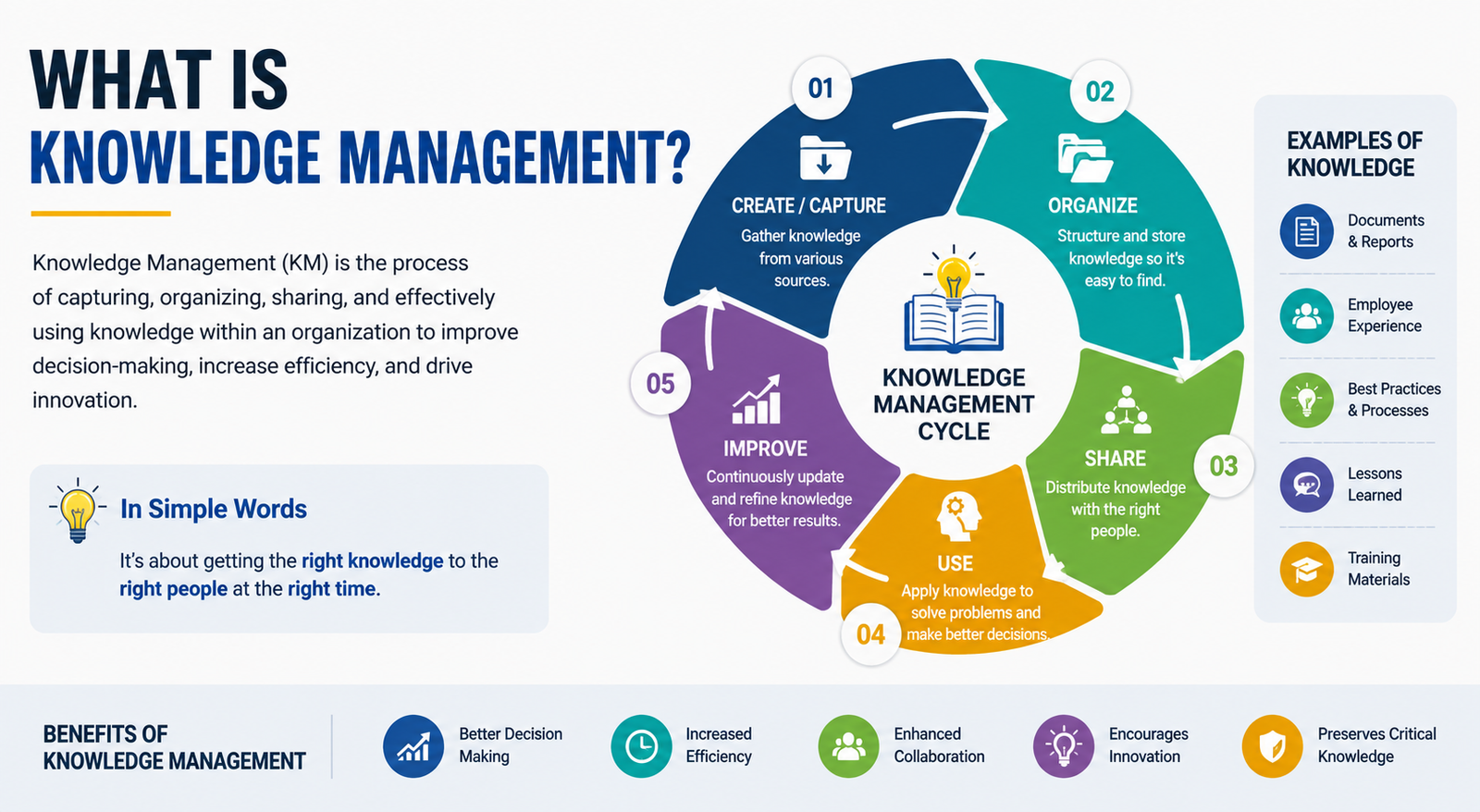
Knowledge is one of the most valuable assets an organization can possess. While technology, equipment, and finances are essential for growth, the ability to capture, organize, share, and use knowledge often determines long-term success. This is where knowledge management comes into play.
Whether you're a business owner, project manager, student, or IT professional, understanding what is knowledge management can help you improve productivity, streamline workflows, and make better decisions. Modern organizations generate vast amounts of information every day, but without an effective strategy, valuable knowledge can become scattered, outdated, or lost when employees leave.
In this guide, you'll learn the knowledge management definition by authors, its different types, benefits, lifecycle, real-world applications, and how businesses use knowledge management systems to create a more efficient workplace. We'll also explore what is knowledge management in business, what is knowledge management in project management, and why knowledge management is becoming even more important in the age of artificial intelligence.
What Is Knowledge Management?
Knowledge management (KM) is the process of creating, collecting, organizing, storing, sharing, and applying knowledge within an organization to improve performance, collaboration, and decision-making.
Simply put, knowledge management ensures that the right information reaches the right people at the right time. Instead of relying on individual employees to remember processes or solve recurring problems, organizations document and distribute knowledge so everyone can benefit.
Knowledge Management Definition by Authors
Many researchers and business experts have defined knowledge management from different perspectives:
Thomas H. Davenport describes knowledge management as the process of capturing, distributing, and effectively using knowledge within an organization.
Ikujiro Nonaka, known for his work on organizational knowledge creation, emphasizes transforming individual knowledge into organizational knowledge through collaboration and continuous learning.
Karl Wiig defines knowledge management as the systematic management of knowledge-related activities to maximize organizational value.
Although the wording differs, every definition shares one common goal: using knowledge effectively to improve organizational success.
A Simple Example of Knowledge Management
Imagine a customer support team receives the same technical question every day. Instead of having each employee write a new response, the company creates a searchable knowledge base containing the solution. Whenever the issue appears again, support agents quickly find the answer, reducing response time and ensuring consistent service.
This simple practice demonstrates knowledge management in action.
Why Is Knowledge Management Important?
Organizations operate in increasingly competitive and information-rich environments. Without proper knowledge management, valuable expertise can disappear when employees leave, departments may duplicate work, and decision-making becomes slower.
Here are some of the biggest reasons why knowledge management is important:
Improves decision-making with accurate information
Increases employee productivity
Reduces duplicated work
Preserves organizational knowledge
Enhances collaboration across teams
Speeds up employee onboarding
Improves customer service
Encourages innovation
Supports continuous learning
Strengthens business continuity
For example, a company with well-documented procedures can onboard new employees much faster than one that relies only on verbal training.
What Is Knowledge Management in Business?
Knowledge management in business refers to using organizational knowledge to improve operations, customer satisfaction, innovation, and profitability.
Businesses generate valuable knowledge through:
Customer interactions
Sales reports
Market research
Employee expertise
Internal processes
Product development
Training materials
Instead of allowing this information to remain isolated within departments, companies organize it into centralized systems where employees can easily access and apply it.
For example, a retail company may store sales strategies, inventory procedures, supplier information, and customer insights in one knowledge management platform. Employees across different branches can then access the same up-to-date information, ensuring consistency and efficiency.
Types of Knowledge Management
Not all knowledge is the same. Understanding different knowledge types helps organizations develop effective strategies for capturing and sharing information.
Explicit Knowledge
Explicit knowledge is information that can easily be documented, stored, and shared.
Examples include:
Employee manuals
Company policies
Standard operating procedures
Reports
Training documents
Instruction guides
This type of knowledge is usually stored in digital documents, databases, or knowledge management systems.
Tacit Knowledge
Tacit knowledge comes from personal experience, intuition, and practical skills. It is often difficult to document because it exists in people's minds.
Examples include:
Leadership abilities
Negotiation skills
Technical troubleshooting experience
Creative problem-solving
Relationship-building techniques
Organizations often transfer tacit knowledge through mentoring, coaching, workshops, and collaboration.
Implicit Knowledge
Implicit knowledge refers to knowledge that has not yet been documented but can be explained and recorded when necessary.
Examples include:
Personal workflows
Preferred methods for completing tasks
Team-specific processes
Practical shortcuts developed through experience
Organizations often convert implicit knowledge into explicit knowledge by documenting best practices.
Comparison of Knowledge Types
Understanding these three categories helps organizations capture valuable expertise before it is lost.
How Does Knowledge Management Work?
Knowledge management follows a continuous cycle rather than a one-time process. Organizations constantly create, improve, and distribute knowledge as they grow.
Step 1: Create Knowledge
Knowledge originates from:
Research
Employee experience
Customer feedback
Innovation
Business operations
Every completed project creates new knowledge that can benefit future work.
Step 2: Capture Knowledge
Organizations identify valuable information and record it before it disappears.
Examples include:
Meeting notes
Project documentation
Video tutorials
Technical documentation
Best practice guides
Step 3: Organize Knowledge
Collected information is categorized using folders, tags, departments, or topics so employees can easily locate it.
Proper organization significantly reduces the time spent searching for information.
Step 4: Store Knowledge
Knowledge is stored in secure locations such as:
Cloud platforms
Company intranets
Knowledge management systems
Digital libraries
Document repositories
Centralized storage ensures employees always access the latest version.
Step 5: Share Knowledge
Knowledge becomes valuable only when people can access it.
Organizations share knowledge through:
Internal portals
Team collaboration software
Training sessions
Wikis
Knowledge bases
Workshops
Encouraging a culture of knowledge sharing prevents information silos.
Step 6: Apply Knowledge
Employees use documented knowledge to:
Solve problems
Improve workflows
Train colleagues
Make informed decisions
Deliver better customer service
Practical application transforms stored information into measurable business value.
Step 7: Improve Knowledge
Knowledge management is an ongoing process.
Organizations regularly:
Update outdated content
Remove duplicate information
Add new discoveries
Improve documentation
Collect employee feedback
Continuous improvement ensures knowledge remains accurate and useful.
Core Components of Knowledge Management
Successful knowledge management depends on more than just software. It requires a combination of people, processes, technology, and organizational culture.
People
Employees are the primary source of organizational knowledge. Their expertise, creativity, and collaboration drive continuous learning.
Organizations should encourage employees to document experiences and share insights openly.
Processes
Standardized processes ensure knowledge is consistently captured, reviewed, updated, and distributed across departments.
Clear workflows reduce confusion and improve knowledge quality.
Technology
Technology enables organizations to store, organize, search, and distribute information efficiently.
Common technologies include:
Knowledge bases
Cloud storage
Enterprise search tools
Collaboration platforms
AI-powered document management
Internal wikis
Organizational Culture
A strong knowledge-sharing culture encourages employees to contribute information without hesitation.
Organizations that reward collaboration often experience greater innovation and stronger teamwork.
Governance
Governance establishes rules for:
Content ownership
Version control
Security
Access permissions
Content reviews
Compliance
Good governance ensures knowledge remains reliable and trustworthy.
Benefits of Knowledge Management
Implementing a knowledge management strategy provides measurable advantages for organizations of all sizes.
Key benefits include:
Faster access to information
Better collaboration across departments
Increased employee productivity
Improved customer satisfaction
Reduced operational costs
Faster employee onboarding
Better decision-making
Greater innovation
Reduced risk of losing valuable expertise
Stronger competitive advantage
For example, an IT company with a centralized troubleshooting database allows technicians to solve recurring technical issues in minutes instead of hours, improving both efficiency and customer satisfaction.
What Is a Knowledge Management System?
A Knowledge Management System (KMS) is software designed to collect, organize, store, and distribute organizational knowledge in a centralized location.
In other words, if knowledge management is the overall strategy, a knowledge management system is the technology that makes that strategy practical and scalable.
A modern KMS allows employees to quickly search for documents, procedures, FAQs, training materials, project files, and best practices without wasting time looking through emails or multiple folders.
Common features include:
Centralized knowledge repository
Powerful search functionality
Document version control
User permissions and access controls
Collaboration tools
Content categorization and tagging
AI-powered recommendations
Analytics and reporting
Organizations use knowledge management systems to ensure that valuable information remains accessible, accurate, and easy to update, helping teams work more efficiently and make informed decisions.
Popular Knowledge Management Tools
Choosing the right knowledge management system depends on your organization's size, budget, and collaboration needs. While every platform has unique features, the goal is the same: make knowledge easy to find, share, and maintain.
When evaluating tools, consider ease of use, search capabilities, security, scalability, AI features, and integration with your existing software.
What Is Knowledge Management in Project Management?
Knowledge management in project management involves capturing lessons learned, project documentation, risks, best practices, and outcomes so future projects benefit from previous experience.
Without knowledge management, project teams often repeat mistakes or spend time solving problems that have already been addressed.
Examples include:
Recording lessons learned after project completion
Maintaining project templates
Documenting risks and solutions
Sharing technical documentation
Creating reusable workflows
For example, a construction company can document successful project schedules and safety procedures. Future teams can use these documents to improve efficiency and reduce delays.
Real-World Knowledge Management Examples
Knowledge management is used across almost every industry.
Healthcare
Hospitals maintain treatment guidelines, medical procedures, and patient care protocols so doctors and nurses can provide consistent care.
Education
Schools and universities organize learning materials, research papers, recorded lectures, and curriculum documents for students and teachers.
Information Technology
IT companies maintain internal documentation for software deployment, troubleshooting, coding standards, and system architecture.
Customer Support
Support teams build searchable knowledge bases containing FAQs, troubleshooting guides, and product documentation, allowing customers to find answers quickly.
Human Resources
HR departments store onboarding materials, company policies, employee handbooks, and training resources in centralized repositories.
These knowledge management examples demonstrate how organized information improves productivity, reduces errors, and supports continuous learning.
AI and Knowledge Management in 2026
Artificial intelligence is transforming how organizations manage knowledge.
Instead of manually searching through thousands of documents, employees can use AI-powered search assistants that understand natural language and provide relevant answers within seconds.
Modern AI capabilities include:
Intelligent document search
Automatic document summarization
Smart tagging and categorization
AI chatbots for employee support
Knowledge recommendations
Duplicate content detection
Predictive search
Retrieval-Augmented Generation (RAG)
Voice-based enterprise search
AI helps employees spend less time searching for information and more time applying it effectively.
However, organizations should still verify AI-generated responses to maintain accuracy and compliance.
Common Challenges in Knowledge Management
Although knowledge management offers significant benefits, organizations often face several challenges during implementation.
Common obstacles include:
Information scattered across multiple systems
Employees reluctant to share knowledge
Outdated documentation
Duplicate content
Poor search functionality
Lack of ownership
Security and privacy concerns
Inconsistent documentation standards
Addressing these challenges requires strong leadership, clear governance, and regular content maintenance.
Best Practices for Successful Knowledge Management
Organizations that succeed with knowledge management follow proven best practices.
These include:
Develop clear documentation standards.
Encourage employees to share expertise.
Assign content owners for every knowledge area.
Review and update documentation regularly.
Use consistent tags and categories.
Implement version control.
Train employees on knowledge-sharing practices.
Protect sensitive information with access controls.
Use AI to improve search and organization.
Measure performance using key metrics.
Creating a culture where knowledge sharing is encouraged is often more important than the software itself.
How to Implement Knowledge Management
Implementing knowledge management doesn't have to be complicated. Following a structured approach increases the chances of success.
Step 1: Define Your Goals
Determine what you want to achieve, such as improving customer service, reducing onboarding time, or increasing collaboration.
Step 2: Audit Existing Knowledge
Identify where knowledge currently exists, including documents, emails, spreadsheets, and employee expertise.
Step 3: Select the Right Platform
Choose a knowledge management system that matches your organization's size, security requirements, and budget.
Step 4: Organize Information
Group documents into logical categories with consistent naming conventions and metadata.
Step 5: Train Employees
Show employees how to create, update, and use knowledge effectively.
Step 6: Launch and Monitor
Introduce the system gradually and gather employee feedback to improve usability.
Step 7: Continuously Improve
Review content regularly, remove outdated information, and measure performance using key metrics.
Measuring Knowledge Management Success
Organizations should evaluate whether their knowledge management strategy is delivering measurable results.
Useful Key Performance Indicators (KPIs) include:
Time required to find information
Search success rate
Knowledge article views
Employee productivity
Customer Satisfaction (CSAT)
First Contact Resolution (FCR)
Ticket deflection rate
Content freshness
Employee participation
Number of knowledge contributions
Tracking these metrics helps identify opportunities for continuous improvement.
Future of Knowledge Management
The future of knowledge management will be shaped by AI, automation, and smarter collaboration.
Emerging trends include:
AI-powered enterprise assistants
Personalized knowledge recommendations
Knowledge graphs
Intelligent automation
Predictive search
Hybrid workplace collaboration
Real-time content generation
Continuous organizational learning
Organizations that embrace these technologies will improve decision-making and remain more competitive in the digital economy.
Common Mistakes to Avoid
Many organizations struggle because they overlook fundamental principles of knowledge management.
Avoid these common mistakes:
Treating knowledge management as only an IT project
Failing to update documentation
Ignoring employee feedback
Creating overly complex systems
Not assigning content ownership
Allowing duplicate or outdated information
Neglecting employee training
Measuring nothing after implementation
Regular reviews and continuous improvement help maintain a valuable knowledge repository.
Conclusion
Knowledge management is far more than storing documents—it is a strategic approach to capturing, organizing, sharing, and applying knowledge to improve organizational performance. Whether you're exploring what is knowledge management in business, implementing knowledge management in project management, or selecting the right knowledge management system, the goal remains the same: ensure valuable knowledge is accessible when it's needed most.
As artificial intelligence continues to evolve, knowledge management is becoming smarter, faster, and more personalized. Organizations that invest in effective knowledge-sharing practices, modern technology, and a collaborative culture will be better positioned to innovate, improve customer experiences, and achieve sustainable growth.
If you're new to the field, consider enrolling in a what is knowledge management course to build practical skills and learn how leading organizations manage their most valuable asset—knowledge.
Frequently Asked Questions
What is knowledge management in simple words?
Knowledge management is the process of collecting, organizing, sharing, and using information so individuals and organizations can work more efficiently and make better decisions.
What is a knowledge management system?
A knowledge management system is software that stores and organizes documents, procedures, FAQs, and other organizational knowledge in one centralized location.
What are some knowledge management examples?
Examples include company knowledge bases, employee training manuals, customer support FAQs, project documentation, internal wikis, and lessons learned repositories.
Why is knowledge management important?
Knowledge management improves productivity, supports collaboration, preserves organizational expertise, speeds up decision-making, and enhances customer service.
What is knowledge management in project management?
It involves documenting project plans, lessons learned, risks, best practices, and outcomes so future projects benefit from previous experience.
Where can I find a What Is Knowledge Management PDF?
Many universities, business organizations, and training providers offer introductory guides and research papers in PDF format. These resources explain concepts, frameworks, and implementation strategies in greater detail.
Is there a knowledge management course for beginners?
Yes. Many universities and online learning platforms offer beginner-friendly courses covering knowledge management fundamentals, systems, organizational learning, and practical implementation.
Leave a Reply